In my last post I said something I want to make good on. If visibility is changing this fast, measurability has to change with it. This is that post.
What’s actually moving
For most of the last two decades, visibility meant a ranking position and a click. That’s no longer true, and the shift happened faster than most teams have been able to adjust to.
Zero-click search, where someone gets their answer directly on the results page and never visits a site, now accounts for well over half of all Google searches, and the number keeps climbing. A June 2026 study from SparkToro and Similarweb found 68 percent of US Google searches ended without a click in the first four months of the year, up from about 60 percent in 2024. AI Overviews now trigger on more than 20 percent of all Google searches, and when one appears, organic click-through rates tend to drop sharply, often by 50 percent or more. Google’s newer AI Mode goes further; it replaces the list of links entirely with a synthesized answer, and it’s already passed a billion monthly users, reportedly doubling in query volume every quarter.
Here’s the part that actually matters for strategy. Brands cited inside AI-generated answers are seeing higher click-through rates on the clicks that do happen, because the person clicking has already read a summary and wants to go deeper. Getting cited is starting to work less like a ranking and more like a referral from a source people already trust.
Why chasing rankings alone stopped working
SEO was built around a simple mechanic: rank higher, earn the click. That mechanic still exists, but it’s no longer the whole game. A newer discipline, usually called answer engine optimization or AEO, focuses on something else entirely: whether AI systems choose your content as a source when building an answer, and whether they get your brand right when they do.
That changes what the content itself has to do. It’s not enough to write for a keyword anymore. The content that gets picked up gives a real answer early, backed by specifics, and stays current. Where you show up matters too, and not just on your own site. These systems pull from dozens of sources at once, so consistency across the web counts for more than it used to.
How I’d structure a team for a moving target
A lot of organizations default to handing this to one person and calling them the AI SEO person. I don’t think that works, for the same reason handing AI tools to one person on a revenue team doesn’t work. Too many functions touch this to live in one seat.
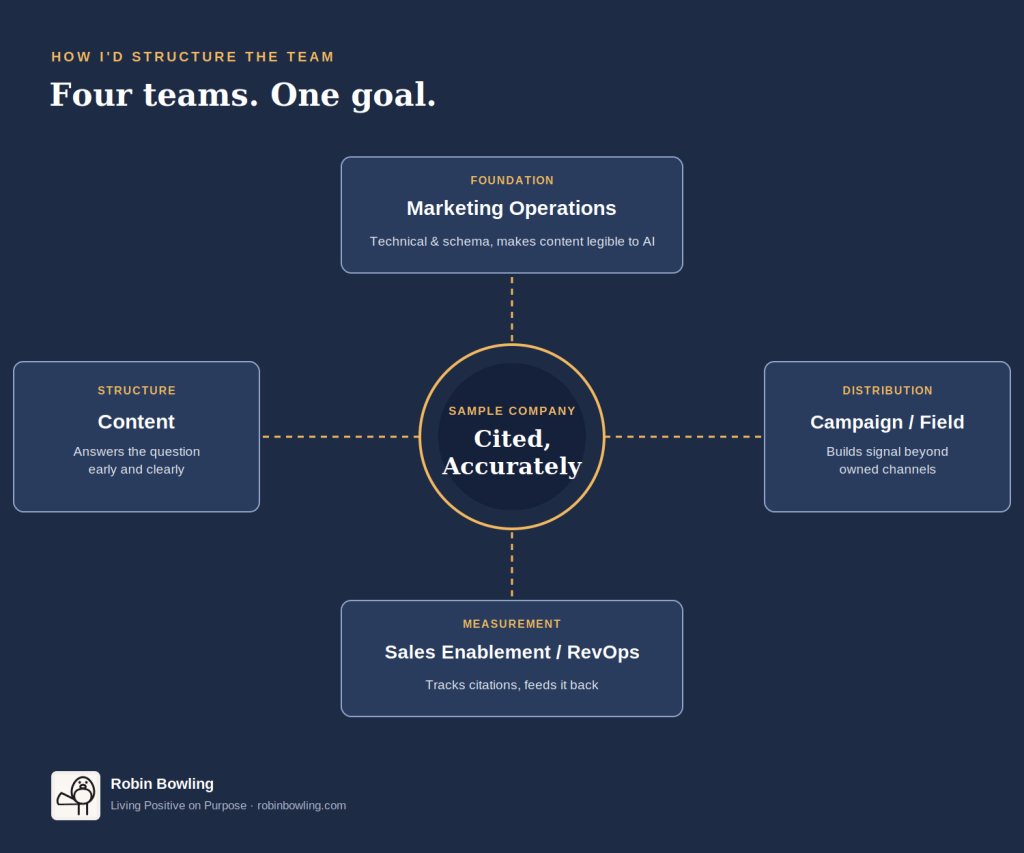
Here’s how I’d split the ownership. Someone owns the technical foundation, schema markup, site structure, and crawlability, the groundwork that makes content legible to search engines and AI systems alike. Another owns the content structure and format, making sure the best material answers the question early rather than burying it three paragraphs in. Someone else owns distribution and authority, as these systems pull from more than your website, and where you appear on review sites, forums, and YouTube feeds directly into whether you get cited. And someone owns measurement because the old dashboard no longer tells this story. Sessions and rankings still matter, but citation frequency, share of voice in AI answers, and whether your brand is described accurately are becoming the finally metrics that explain what’s really happening.
How this actually runs with a team
Naming four owners is the easy part. Making the framework work is different.
Here are the four: Foundation, Structure, Distribution, and Measurement. Next, here’s how they actually work together.
All four meet on a fixed cadence, monthly or bimonthly is usually right, and each brings one number rather than a status update. Foundation reports what got fixed technically. Structure reports on which pieces were rebuilt and whether the answer lands early now. Distribution reports showing where the brand appeared beyond owned channels. Measurement reports the number that ties it together, citation frequency and share of voice, up or down since the last check-in.
That last report keeps the other three honest. When citations stall, the group looks at which vertical is creating the bottleneck instead of defaulting to more written content or chasing a new platform for its own sake. Whoever owns Measurement isn’t just tracking a number; they’re the one steering the next cycle of effort.
The handoffs matter more than the roles themselves. Foundation has to finish before Structure’s rebuilt content gets indexed and read correctly. Structure has to exist before Distribution has anything worth amplifying. Skip that sequencing, and you end up with four separate initiatives running in parallel with nobody comparing notes, which is where most teams actually lose this.
A smaller team, or a personal brand, still needs all four functions covered; they just might be the same person wearing four hats in sequence. What doesn’t change is reporting all four numbers to yourself on a fixed cadence, rather than only doing the part that’s most fun, which for most people is Structure, the actual writing.
How I’d structure personal brand authority: the verticals that build it
Personal brand authority isn’t a single channel; it’s a small set of verticals that all feed into the same goal: showing up accurately in the places people are actually asking the question. Here’s how I’d break those down, using the same wave discipline I use in a real campaign plan.
Owned content is the foundation, the long-form work that gives AI systems something substantial to cite. It only earns citations if it answers the real question early, covers the topic completely instead of splitting it across five thin posts, and includes something original, a named framework, a first-hand data point, a genuine point of view rather than advice restated from somewhere else.
Earned authority covers credentials, guest contributions, podcast appearances, speaking engagements, and third-party validation. AI systems weight this heavily when deciding whether a source is trustworthy enough to cite, which is really the same signal humans have always used to size up authority, just feeding a different kind of decision now.
Social distribution across LinkedIn, Instagram, and TikTok does more than reach an audience directly. It reinforces topical consistency across the same web these systems are crawling, and showing up on the same handful of topics across platforms is what turns a single post into a recognizable point of view.
Community presence, forums, comment sections, and community discussions are becoming a real source of AI-generated answers rather than just an engagement channel. Being part of the actual conversation where your audience asks these questions matters more than it used to.
And measurement ties all four together, tracking citation frequency and share of voice monthly, the same way I’d track MQLs in a revenue funnel, then feeding what’s working back into where the next cycle of effort goes.
Owned content without earned authority reads as unproven. Distribution without owned content has nothing worth amplifying. These verticals only compound when someone’s building them together on purpose, rather than running each one as a disconnected initiative.
How teams are learning about content gaps, and problem versus solution content
A content gap used to mean a keyword you weren’t ranking for. Now it usually means a question your audience is asking inside an AI tool, where a competitor is the one getting cited, and you’re not.
Finding that isn’t guesswork. Pull the real questions your audience asks from sales call transcripts, support tickets, and community forums, not just from a keyword tool. Run those questions across the major AI platforms and see which ones get cited. Wherever a competitor shows up and you don’t, that’s the gap.
The other half is knowing whether a piece of content is even doing the right job in the first place. Problem-aware content meets someone before they know your category exists; they just know something is wrong. Solution-aware content meets someone who already understands the category and is comparing real options. A lot of what looks like a missing topic is actually a topic covered at the wrong stage, a deeply technical comparison piece where the reader needed something that names the problem first. Mapping content to the right stage, the way I mapped buyer stages in the Curve campaign framework from not-in-market through evaluation, is what closes a gap instead of just adding more volume to it.
Where this is headed
Visibility hasn’t gone away. It’s moved, into AI answers, into citations, into brand mentions that never produce a click but still shape the decision. Whoever adjusts their structure and measurements now will still be visible once everyone else has finished arguing about rankings.
This picks up right where the Claude Sonnet 5 post left off, same discipline, applied to how you get found in the first place.
If you’re thinking through how to build a framework like this for your own team, I’d love to talk. Reach out at robo@robinbowling.com or visit www.robinbowling.com.
 Living Positive on Purpose
1 thought on “Visibility Is Now a Moving Target. Here’s How I’d Structure a Team to Keep Up.”