The CMO job today bears little resemblance to what it was like when I started in marketing.
Back then, we were judged on campaigns, leads, and whether people had heard of the brand. Now, CEOs, boards, and investors expect CMOs to own real revenue impact, pipeline predictability, and efficient growth. The title remained the same, but the job description changed.
That shift forced me to rethink what it actually means to lead a marketing function.
It is not just about clever ideas or a big launch anymore. The modern CMO is expected to build a revenue engine you can explain, defend, and improve quarter over quarter. And honestly, a lot of us were not trained for that version of the role. I was not.
What got me there was measurement. Not as an afterthought, not as a quarterly slide deck exercise, but as a core operating capability. Google’s recent work on AI-powered measurement makes the same point: the teams that win are the ones connecting their data, applying AI to understand what is really working, and using those insights to move faster. Measurement has become strategy, not reporting.
The pattern I keep seeing is that the companies that truly understand their numbers grow faster than the ones that do not. It is not complicated. It is just not easy.
Pipeline Starts Earlier Than Most Organizations Want to Admit
One of the most common arguments I have had at almost every company I joined is about when pipeline becomes “real.”
Sales would say the number did not count until it hit a late-stage opportunity in the CRM. I would pull up the data and show deals that closed from leads marketing touched three or four months before they ever appeared as an opportunity. Sometimes that changed the conversation. Sometimes it took longer than it should have.
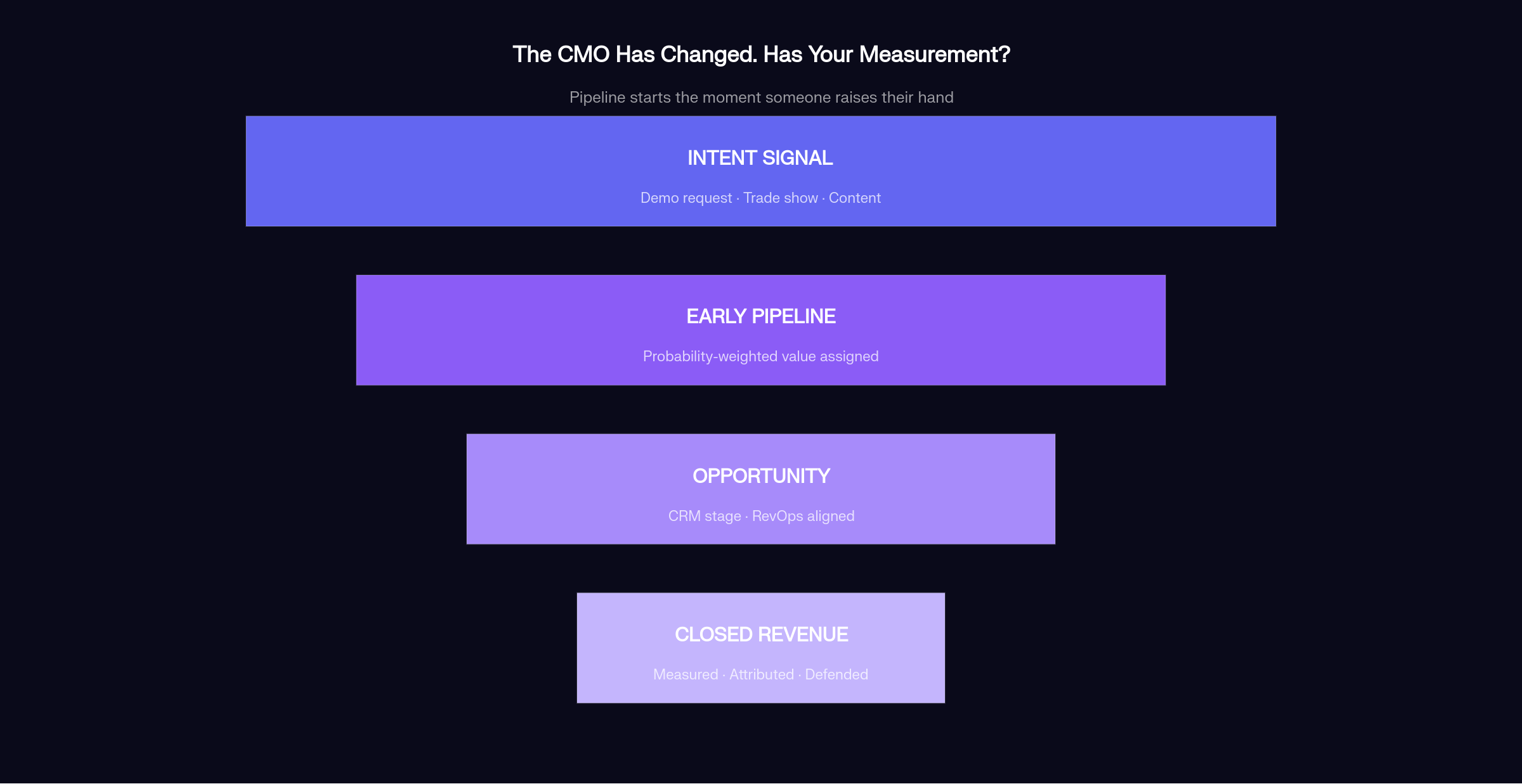
My view is simple: pipeline starts the moment someone raises their hand.
A demo request, a serious conversation at a trade show, a high-intent content download, a referral coming in warm. Those are all signals that real value is forming. If you wait until the CRM opportunity exists to assign any value, you are flying blind on the early funnel and consistently underreporting what marketing is actually contributing.
When you model value earlier, even as a probability or a range, leadership gets a more honest picture of what is coming. You also make it a lot easier to protect the programs that are quietly building the top of the funnel months before any deal closes.
Yes, Trade Shows and Content Are Measurable (If You Design for It)
Trade shows, events, and content get labeled as “brand plays” and left there. I have had this conversation more times than I can count: “We know it matters, we just cannot measure it.”
Most of the time, that is not really true. What is true is that nobody planned the tracking before the initiative launched.
When you design for measurement before you go, you can do things like:
- Tag trade show scans and meetings so they roll up to contacts, opportunities, and closed revenue
- Map content engagement at the account level so you can see which topics appear before a demo or expansion conversation
- Watch branded search and direct traffic lift after events and tie that movement back to pipeline and win rates
I have watched teams completely change where they invest once they finally see the full picture. The “expensive nice to have” turns out to be a quiet driver of pipeline, and suddenly you can prove it. That changes the budget conversation fast.
Revenue Operations: The Partner You Cannot Ignore
If you are trying to build this kind of measurement without a strong Revenue Operations partner, you are going to struggle more than you need to.
RevOps makes sure your systems talk to each other, your funnel definitions actually match, and your reports are not quietly contradicting what sales is seeing in their own dashboards. When RevOps is weak or missing, marketing builds one version of the truth, sales builds another, and leadership ends up choosing which one to believe instead of running the business.
When RevOps is strong, a few things change:
- Funnel stages are shared, not debated every quarter
- Data is cleaner, so the team spends less time fixing spreadsheets and more time acting on what the data says
- Forecasts become believable because they are built on one set of numbers, not three competing ones
The best CMOs I have worked with and learned from treat RevOps as a strategic ally. I learned to put them in the room when we are planning, not only when we need something pulled.
Your Team Has to Speak Revenue, Not Just Marketing
This one is harder to talk about, but it is real.
Creativity, strategy, and strong instincts still matter. They are not going away. But if your team has no interest in the numbers, the function will always be seen as a cost center, and you will spend a lot of your time defending budgets instead of growing them.
I do not need everyone building complex attribution models. I do need them to understand things like:
- What counts as pipeline and why the definition matters
- Where prospects tend to stall in the funnel and why
- Which channels actually move deals forward, versus which ones generate activity that looks good but does not convert
When people understand basic funnel math and can connect their work to revenue, their decisions get sharper. They stop measuring success by impressions alone. They start asking better questions and suggesting smarter experiments.
AI Should Be Doing the Heavy Lifting, Not Your Team
Let me be direct: there is no good reason for a senior marketing team to spend three weeks manually pulling numbers for a quarterly business review.
I have walked into organizations where genuinely talented people were stuck copying data between spreadsheets for hours, stitching together a story that was already out of date before anyone read it. Once, I watched someone spend the better part of a day rebuilding a report that an integrated system would have refreshed automatically overnight. It is painful to watch and expensive to tolerate.
This is exactly where AI and modern analytics tools earn their keep:
- Pulling data from multiple systems automatically
- Cleaning and normalizing it without manual intervention
- Applying attribution logic and running scenario analysis faster than any analyst can in a spreadsheet
The point is not to replace people. The point is to free them for the work that actually requires judgment: strategy, messaging, experimentation, and cross-functional alignment with sales and product.
If AI handles the repetitive measurement work, your team can focus on the things that move the business.
Know Your Measurement Reality
Here is something I do not see discussed enough in marketing leadership circles: measurement maturity should shape how you prioritize your work, regardless of whether you are in a new role or have been in the same seat for three years.
If you are exploring a new opportunity, understanding the measurement infrastructure before you sign on to own a number is non-negotiable. But if you are already in the role, the same questions apply. They just become a diagnostic instead of an interview question.
Ask yourself honestly:
- How do you define each stage of the funnel today, and does everyone agree on those definitions?
- Can you show marketing’s influence on revenue right now, with confidence?
- When does pipeline get value assigned, at the first signal of intent or only at a late CRM stage?
- Are your CRM and marketing automation actually in sync, or are there shadow systems nobody talks about?
- Do you track the real impact of trade shows and content, or is it mostly anecdotal and gut feel?
If most of the answers are “not yet,” that is not a reason to panic. It is a prioritization signal. It means your most important work right now is not a bold new campaign or a channel expansion. It is building the foundation that makes any campaign worth running and any result defensible.
Some of the most valuable work I have done in my career was not a product launch or a rebrand. It was getting a leadership team aligned on definitions, cleaning up dashboards, and creating a single view of the funnel that everyone actually trusted. That work is less visible. It rarely gets applause. It is also what makes everything else possible, and it is the kind of contribution that builds your credibility as a leader over time, whether you are six months into a role or six years in. what makes everything else possible.
The CMO Measurement Readiness Checklist
Before you can grow faster, you have to know where you actually stand. Work through this honestly. The gaps are where your leverage is.
Funnel and Pipeline
[ ] Funnel stages and definitions are documented and shared across marketing, sales, and RevOps
[ ] Pipeline value is assigned at early intent signals, not only at late CRM stages
[ ] Probability-weighted or range-based values exist for top and mid-funnel activity
Systems and Data
[ ] CRM and marketing automation are integrated and syncing cleanly
[ ] No critical data lives in shadow systems or disconnected spreadsheets
[ ] An attribution model is in place and leadership trusts it enough to act on it
Program Measurement
[ ] Trade show and event interactions are tagged and tied to contacts and opportunities
[ ] Content engagement is tracked at the account level
[ ] Brand investment is connected to search behavior, conversion velocity, and win rates
Team and Operations
[ ] The marketing team understands funnel definitions and basic revenue metrics
[ ] AI or automated tools are handling routine data pulls and reporting
[ ] RevOps is a planning partner, not just a reporting function
Leadership Alignment
[ ] Marketing can show its influence on pipeline and revenue with confidence today
[ ] Forecasting reflects the full customer journey, not only late-stage deals
[ ] Budget decisions are driven by data, not gut feel or internal politics
If you checked fewer than half of these, the measurement foundation is not there yet. That is actually the most important thing to know, because now you can prioritize fixing it.
The Modern CMO’s Real Job: Build Confidence
If I had to reduce all of this to one idea, it would be that the modern CMO’s job is to create confidence.
Confidence for the CEO and board that the investment in marketing will turn into growth. Confidence for sales that the pipeline is real and not inflated. Confidence for the team that their work matters and can be proven.
Measurement builds that confidence. So does a strong RevOps partnership, a team that speaks revenue, and smart use of AI to remove the friction that slows everything down.
The CMO role is not shrinking. It is expanding in ways most of us did not anticipate when we took our first leadership jobs.
We are no longer just telling the story of the business; we are helping build the system that drives it.
If this resonated with you, I would love to hear where your organization is on this journey. Drop a comment below or connect with me directly. And if you are a CMO or marketing leader working through any of these challenges, feel free to reach out. These are conversations worth having.
 Living Positive on Purpose